
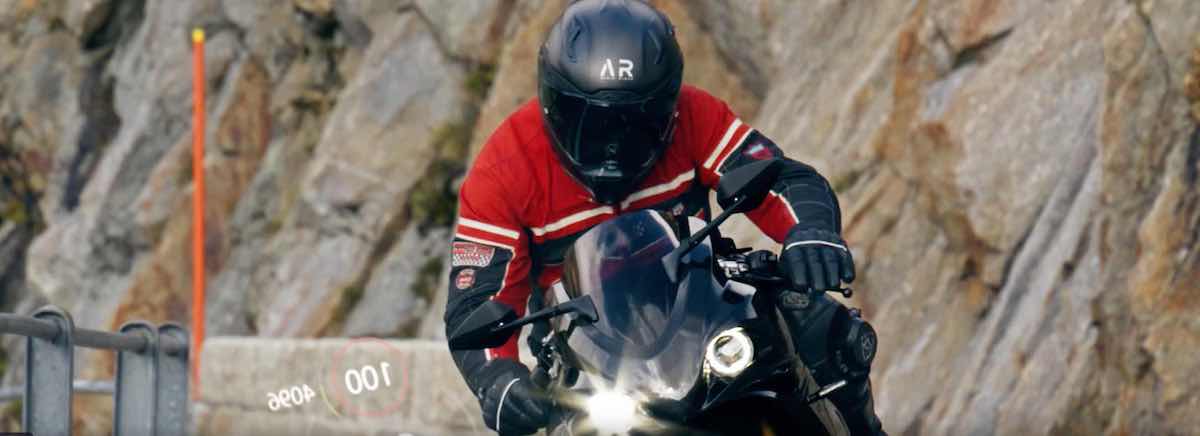
TVS Motor Company, in collaboration with Swiss tech partner Aegis Rider, has unveiled a groundbreaking augmented reality (AR)-enabled helmet that could redefine how riders interact with their motorcycles and the road ahead. Debuted at the prestigious EICMA 2025 — one of the world’s largest motorcycle trade shows in Milan — the TVS Aegis Rider Vision Helmet integrates a spatially anchored heads-up display (HUD) directly into the rider’s field of vision, projecting vital information such as navigation cues, speed, hazard alerts, ride notifications and incoming calls without ever forcing the rider to look away from the road.
The AR helmet represents a significant leap forward in connected riding gear, marrying advanced display technology with real-world usability. At its core is a binocular µOLED projector system embedded within a carbon-fibre helmet shell, capable of creating a stable, high-contrast digital overlay that remains visible and properly aligned regardless of head movement or lighting conditions. Adaptive brightness and anti-glare functionality ensure that riders can view critical information under bright sunlight as well as in low-light environments. A powerful Qualcomm processor and a 7,000 mAh battery support up to four hours of continuous AR operation, enabling extended touring and daily commuting alike without frequent recharging.
Connectivity is a standout feature of the helmet. It links wirelessly to both the motorcycle’s infotainment system and a rider’s smartphone, allowing real-time display of GPS navigation, speed, RPM, gear position, fuel level, turn-by-turn prompts and other insights that previously required a glance at the dash or a handheld device. The helmet also boasts global safety certifications such as ECE 22.06 and DOT, ensuring that the cutting-edge technology does not compromise rider protection. An integrated 5 MP action camera rounds out the feature set, enabling riders to record their journeys or capture unexpected moments on the road.
Behind this innovation lies years of R&D, with TVS and Aegis Rider focusing on spatial anchoring — the ability to fix digital information in the physical world so that it stays in place relative to the rider’s view. This capability helps present data intuitively, as though it were part of the external environment rather than a distraction or overlay. The technology was showcased in live demos at EICMA, often installed on TVS’s flagship motorcycles such as the Apache RTR 310, highlighting how the display works in concert with real riding dynamics.
Industry observers see the AR helmet as part of a broader move toward connected mobility ecosystems that extend beyond the bike itself. TVS has been actively expanding its TVS Connect platform — a suite of digital services and connected features that links vehicles, apps, wearables and cloud analytics to elevate safety, convenience and personalization. The HUD AR helmet aligns seamlessly with this vision, offering riders a hands-free, eyes-forward interface that prioritizes awareness and reduces distractions on the move.
Looking ahead, enhancements to the system are expected to include ride assistance algorithms, vehicle-to-everything (V2X) communication, and cloud-based ride analytics, enabling even smarter routing, predictive alerts, and deeper integration with other vehicles and infrastructure. As motorcycle and smart gear technologies converge, innovations like TVS’s AR helmet could become a new standard in rider safety, blending digital intelligence with real-world riding performance to create a more intuitive and connected journey for riders everywhere.

