
Beyond Passive Recording: Why India’s Commercial Fleets Are Ready for an AI Dash Cam Mandate

Author: Ravi Teja Alchuri
For years, the commercial fleet industry viewed dash cameras as simple retrospective tools. They were digital eyewitnesses stored on SD cards, useful only after an accident occurred. If a truck was involved in a collision, we pulled the footage, reviewed the seconds leading up to the impact, and determined fault. It was a reactive process that did nothing to prevent the incident in the first place.
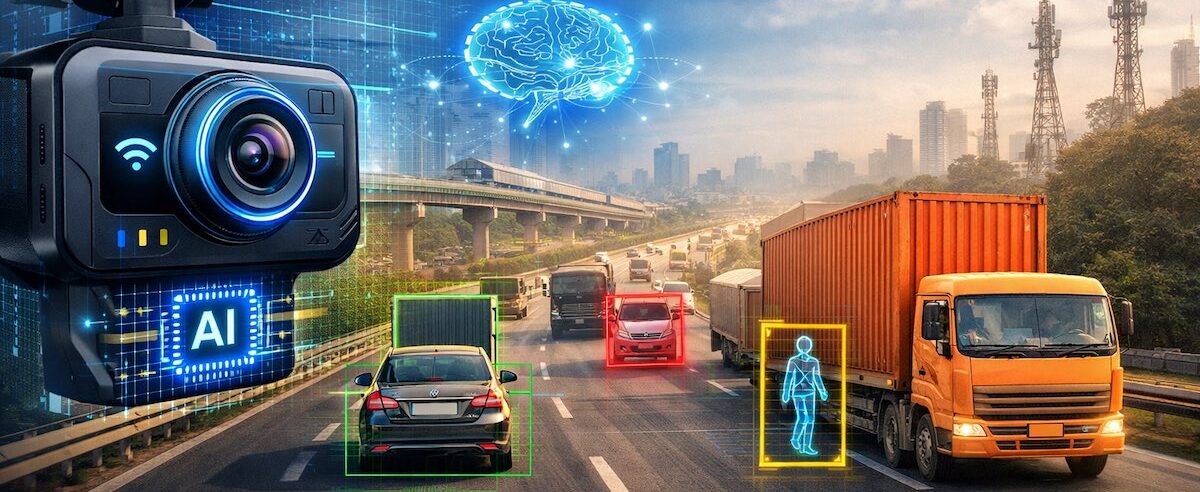
That era is over. The convergence of edge computing, computer vision, and deeper telematics integration has fundamentally changed the hardware profile of the modern dash cam. We are no longer mounting simple video recorders on windshields. We are deploying intelligent edge nodes capable of real-time inference.
For the Indian commercial transportation sector, this technological shift arrives at a critical moment. With road safety statistics remaining a pressing concern and logistics density increasing, the passive tracking systems of the past decade, primarily location-based, are no longer sufficient. India is ready for a phased, intelligent mandate that integrates video telematics into the regulatory framework.
From Storage to Edge Inference
The most significant technical evolution in dash cams is the shift from cloud-dependent processing to edge inference. In early iterations of connected cameras, the device would stream video to a server where algorithms would attempt to analyze driver behavior. This approach suffered from latency and prohibitive data costs, especially in regions with inconsistent cellular coverage.
Modern AI dash cams process video streams locally on the device. Dedicated Neural Processing Units (NPUs) or powerful SoCs (System on a Chip) analyze every frame in milliseconds. They detect lane departures, forward collision risks, and driver drowsiness without needing to send a single byte of data to the cloud.
This low-latency architecture is non-negotiable for safety. If a driver is falling asleep behind the wheel of a heavy commercial vehicle, a warning that arrives three seconds late due to network lag is useless. The alert must be immediate. The device only uploads metadata or short video clips of the specific event to the cloud for fleet manager review. This approach respects bandwidth constraints while ensuring critical safety alerts happen in real time.
The Necessity of Sensor Fusion
While visual data is powerful, it is rarely enough on its own. A camera can see a car cutting off a truck, but it cannot tell you if the truck driver reacted by braking or accelerating. This is where the integration of AI video with On-Board Diagnostics (OBD) and CAN bus data becomes essential.
True fleet intelligence requires sensor fusion. We must correlate the visual data (object detection, lane position) with vehicle telemetry (speed, engine RPM, brake pressure, accelerator position).
Consider a “harsh braking” event. A standard telematics unit might flag a deceleration of 0.5g as a harsh brake, penalizing the driver. However, video context might show a child running into the road. In that context, the harsh brake was a lifesaving maneuver, not poor driving. Conversely, if the OBD data shows the truck was speeding significantly over the limit before that brake application, the context shifts back to driver negligence.
By combining the vision layer with the vehicle’s internal sensor network, we eliminate ambiguity. We move from guessing what happened to knowing the physics and the context of every event.
Surveillance and the Liability Shield
The operating environment for commercial vehicles in India is complex. Mixed traffic conditions where heavy trucks share lanes with two-wheelers, pedestrians, and livestock create high-liability scenarios. Fleet operators often face immediate presumption of guilt in accidents involving smaller vehicles.
AI dash cams serve as an objective layer of protection. They provide irrefutable evidence in dispute resolution. In my experience designing fleet systems, I have seen countless instances where video evidence exonerated a commercial driver who was cut off or victims of “crash-for-cash” scams.
This is not just about avoiding insurance payouts. It is about protecting the livelihood of the driver and the operational continuity of the fleet. When an accident occurs, the ability to instantly access video clips and telemetry data allows fleet managers and legal teams to make informed decisions within minutes, rather than waiting days for police reports.
Real-Time Prevention and the Human Factor
The capability of these systems to monitor the driver often referred to as Driver Monitoring Systems (DMS) is perhaps the most sensitive yet valuable feature. Using inward-facing cameras and facial landmark tracking, these systems detect fatigue, distraction, and mobile phone usage.
The goal here must be coaching, not punishment. If a system constantly beeps at a driver for every minor head movement, they will tape over the lens. The technology must be tuned to minimize false positives. It needs to distinguish between a driver checking a side mirror and a driver staring at a smartphone.
When implemented correctly, real-time in-cab alerts act as a co-pilot. They nudge the driver back to attention before a critical error occurs. Over time, this data aggregates into a driver risk profile, allowing fleet managers to identify who needs training rather than who needs firing. This creates a safety culture based on improvement rather than fear.
Why India is Ready Now
Technologically and operationally, the barriers to adoption in India have lowered significantly.
First, hardware costs have stabilized. The computing power required to run efficient computer vision models is now available in cost-effective chipsets. We are no longer talking about expensive, server-grade hardware.
Second, connectivity has matured. While 100% video streaming is impractical, India’s 4G infrastructure is more than capable of handling the “event-based” architecture where only 10-second clips of critical incidents are uploaded.
Third, the ecosystem is prepared. The implementation of AIS-140 introduced the concept of mandatory tracking and panic buttons to the industry. The market understands the basic premise of telematics. Moving from “dot on a map” to “eyes on the road” is the natural progression of this digital infrastructure.
A Framework for Regulation
A mandate for AI dash cams should not be a blanket enforcement overnight. It requires a pragmatic, phased approach.
Regulators should consider prioritizing high-risk categories first: hazardous material carriers, passenger buses, and long-haul heavy commercial vehicles. These segments pose the highest risk to public safety and stand to gain the most from accident prevention technology.
Furthermore, standardization is critical. We cannot have a fragmented market of proprietary video formats that police or insurance agencies cannot access. Standards for data retention, privacy masking (blurring faces of public bystanders), and interoperability must be established early. We need to ensure that the data remains secure and that privacy concerns regarding driver monitoring are addressed through clear data governance policies.
The Path Forward
The technology to drastically reduce road accidents in India exists today. It is tested, robust, and operating at scale in other markets. We are not waiting for a breakthrough. We are waiting for adoption.
By integrating AI-driven vision with existing telematics frameworks, we can transform commercial vehicles from heavy risks into intelligent, safety-aware assets. It requires collaboration between OEMs, technology providers, and policymakers to set the standards. The cost of implementation is a fraction of the cost of the lives and assets currently lost on our roads. The time to move beyond passive recording is now.
References & Further Reading
- Ministry of Road Transport and Highways (MoRTH), Government of India. Road Accidents in India. Annual Reports (2023-2024).morth.nic.in
- Automotive Research Association of India (ARAI). AIS-140 Standard: Intelligent Transportation Systems (ITS) – Requirements for Public Transport Vehicle Operation.araiindia.com
- The Hindu. Road accident deaths rise to 1.77 lakh in 2024: Gadkari. (December 05, 2025).thehindu.com
- Global Market Insights. Video Telematics Market Size & Growth Reports (2024-2034). Indicating ~17.9% CAGR and strong growth in APAC.gminsights.com
- SNS Insider. AI Dash Cams Market Size, Share & Growth Report, 2032. Highlighting the shift toward edge AI processing.snsinsider.com
About the Author
Ravi Teja Alchuri is a Director of Technology with over a decade of experience building and scaling fleet management, telematics, and compliance-critical platforms. He has worked extensively on ELD systems, device-to-cloud architectures, and AI-driven fleet analytics, focusing on reliability, safety, and real-world operational impact. He is an IEEE Senior Member.


