
Volkswagen Group begins real-world autonomous testing with its Gen.Urban research vehicle

Press release, 12 December 2025
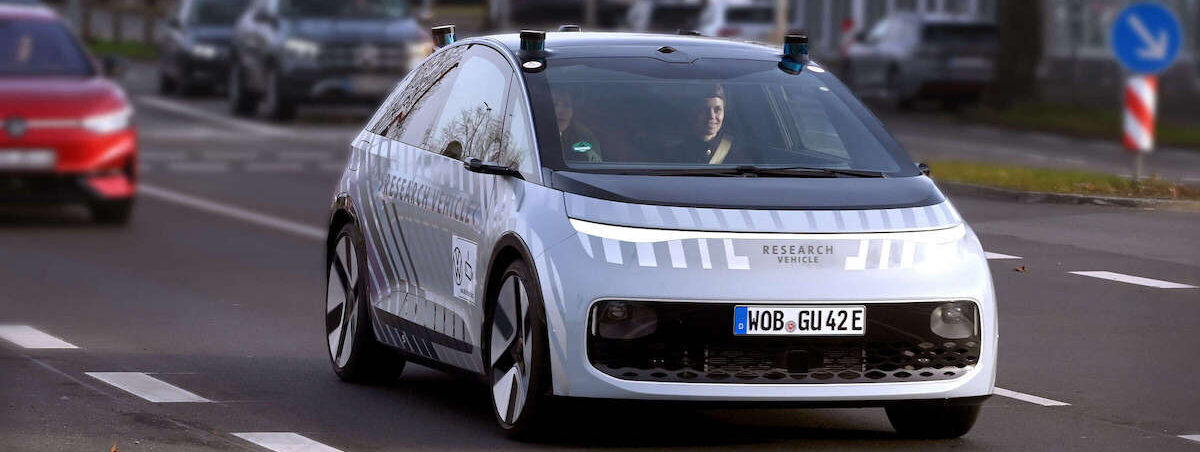
The Volkswagen Group has officially launched a new phase of autonomous vehicle testing in the city of Wolfsburg, Germany, putting its innovative Gen.Urban research vehicle into real urban traffic for the first time. This trial marks a milestone in the company’s exploration of future mobility and passenger experience inside self-driving vehicles, and brings autonomous tech out of controlled environments onto everyday city streets.
The Gen.Urban prototype is no ordinary test car — it deliberately omits traditional steering wheel and pedals, as it is designed purely as a research platform to understand how people interact with and respond to autonomous mobility. Instead of focusing on how a person might control a vehicle, Volkswagen’s goal with this project is to discover how passengers feel, engage, and interact with the environment and technology during autonomous journeys.
The testing route is a nearly ten-kilometre loop through real urban traffic in Wolfsburg, including intersections, roundabouts, residential and industrial areas, typical construction zones, and common traffic scenarios. Each test run lasts around 20 minutes and is conducted under monitored conditions to ensure safety. While the Gen.Urban drives itself, a trained safety driver sits in the passenger seat, ready to intervene via a special control panel and joystick if necessary.
A human-centric approach to autonomous mobility
What sets the Gen.Urban project apart from many autonomous vehicle tests is its focus on the human experience rather than purely on technical performance. Volkswagen’s interdisciplinary team — including designers, human factors specialists, software engineers, and materials experts — is collecting data not only on the vehicle’s autonomous systems, but also on how passengers behave, feel, and interact while inside the car. This includes insights into:
- Passenger comfort and trust levels during autonomous rides
- Preferences for in-vehicle environments, such as cabin temperature, lighting, sound, and ambience
- How passengers choose to spend their time — whether working, relaxing, or engaging with digital content
- User interface expectations and needs, especially for older adults and younger occupants
All of this data is intended to feed into Volkswagen’s broader strategy of designing future vehicles that are not only technologically advanced but also intuitively aligned with people’s real-world needs and expectations.
Before a journey begins, passengers can personalise their ride preferences through an app or directly within the cabin, setting everything from climate control to lighting themes. The Gen.Urban then automatically adjusts the seat and interior settings based on these inputs, creating a highly customisable experience tailored to individual tastes. A wide front display adapts to each passenger using built-in artificial intelligence, enhancing the sensory experience with personalised visuals, light, and sound.
Why Wolfsburg? Why now?
Wolfsburg, home to Volkswagen’s headquarters, provides an ideal urban testbed where engineers can assess autonomous driving systems in live traffic conditions that mimic everyday driving more accurately than closed test tracks. This transition to real-world environments is significant — it moves autonomous research beyond simulations and staged environments into the complex dynamics of actual city streets, with all their unpredictability.
According to Volkswagen’s Head of Group Innovation, Dr. Nikolai Ardey, the company’s ambition is not just to develop autonomous technology, but to build trust and comfort in future mobility solutions by placing people at the centre of the experience. The insights from this testing phase are expected to influence user experience design across the Group’s brands, shaping how autonomous vehicles will interact with passengers in the years to come.
What’s next?
The current test phase involves Volkswagen Group employees and is expected to run for several weeks. The findings from this period will be crucial in refining both the technical capabilities and the interior experience of future autonomous vehicles. While the Gen.Urban itself is a research prototype that won’t be sold commercially, the lessons learned from these urban tests could directly influence next-generation autonomous systems and user environments across Volkswagen’s portfolio.
As automakers worldwide race to develop safe, reliable autonomous vehicles, Volkswagen’s human-centred approach with the Gen.Urban underscores a growing industry shift — one that prioritises real-world usability and passenger comfort just as much as technological performance.


