
Press Release, 15 October 2025
The ongoing US–China trade war is reshaping the global rare earth landscape, pushing Western nations to invest heavily in domestic supply chains to secure critical materials essential for defense and clean energy technologies. According to IDTechEx’s latest report, “Rare Earth Magnets 2026–2036: Technologies, Supply, Markets, Forecasts,” 2025 marks a turning point as rising tariffs and export restrictions from China accelerate the push for local production in the US and Europe.
China currently dominates the rare earth market, mining 69% of the world’s supply and refining nearly 90% of rare earth metals. Recent Chinese export controls targeting materials such as erbium, holmium, and neodymium—vital for electric motors and defense systems—have intensified global supply concerns. The impact has already rippled across industries, forcing automakers like Ford to halt production temporarily due to material shortages.
In response, the US government is driving rapid investment in domestic capacity. The Department of Defense has partnered with MP Materials, injecting over $400 million to expand North America’s only major rare earth mine. Companies like USA Rare Earths and Noveon Magnetics are following suit, with acquisitions and long-term supply deals aimed at building a fully independent rare earth ecosystem—from mining to magnet production. These efforts aim to shield the US supply chain from future geopolitical disruptions and dependency on China.
Europe is also making strides, with France-based Carester securing €216 million in funding to establish a major rare earth separation plant. Working alongside Solvay and Neo Performance Materials, Europe plans to process both mined and recycled rare earth materials to strengthen its strategic autonomy.
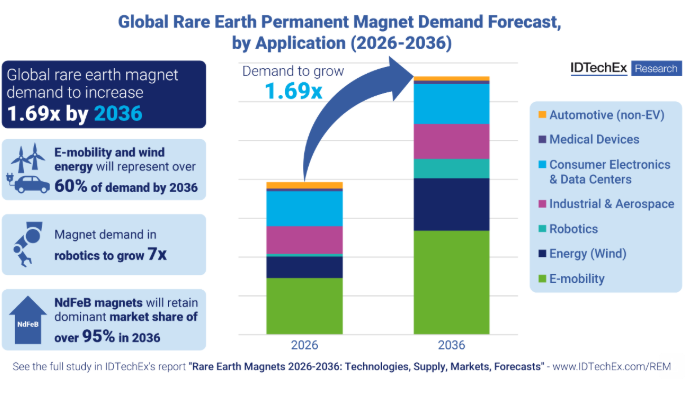
Despite these advancements, challenges remain—particularly the scarcity of heavy rare earth elements outside China and Myanmar. IDTechEx projects that global demand for rare earth magnets will grow 69% by 2036, driven primarily by electric mobility, robotics, and renewable energy technologies. The race to secure sustainable, diversified supply chains is now a defining element of the global clean tech and defense industries.


