

As vehicles evolve into data-driven machines on wheels — connected, autonomous, and software-defined — automotive cybersecurity has become a mission critical concern. The modern car generates, transmits, and processes massive volumes of sensitive data. From driver behavior and biometric identity to vehicle-to-everything (V2X) communication, the attack surface is expanding rapidly.
While traditional encryption protects data at rest or in transit, it leaves a critical vulnerability: data must be decrypted to be processed, exposing it to potential attacks. This is where homomorphic encryption (HE) steps in — offering a revolutionary way to keep data encrypted, even during computation.
What is Homomorphic Encryption?
Homomorphic encryption is a form of encryption that allows computations to be carried out directly on encrypted data (ciphertext), producing an encrypted result. When this result is decrypted, it matches the outcome of operations performed on the original plaintext.
In simpler terms:
Imagine a mechanic fixing your engine while it’s still locked in the car — that’s what HE allows for your data.
There are three main types:
- Partially Homomorphic Encryption (PHE) – Supports one operation (addition or multiplication)
- Somewhat Homomorphic Encryption (SHE) – Supports limited operations
- Fully Homomorphic Encryption (FHE) – Supports unlimited operations and is the most powerful (but also the most computationally demanding)
Automotive Cybersecurity: Challenges on the Road
As vehicles become digital platforms, they face growing cybersecurity risks:
| Challenge | Description |
|---|---|
| Data Privacy | Vehicles collect personal data (location, preferences, biometrics) that must be protected. |
| V2X Vulnerabilities | Communication between vehicles, infrastructure, and the cloud is vulnerable to interception or spoofing. |
| Cloud Dependence | AI-driven functions rely on cloud-based processing of sensor data, increasing exposure. |
| OTA Updates | Over-the-air software updates are critical but can be a target for injection attacks. |
| Collaboration Risks | OEMs and suppliers need to share data, but doing so without leaking IP or user data is tricky. |
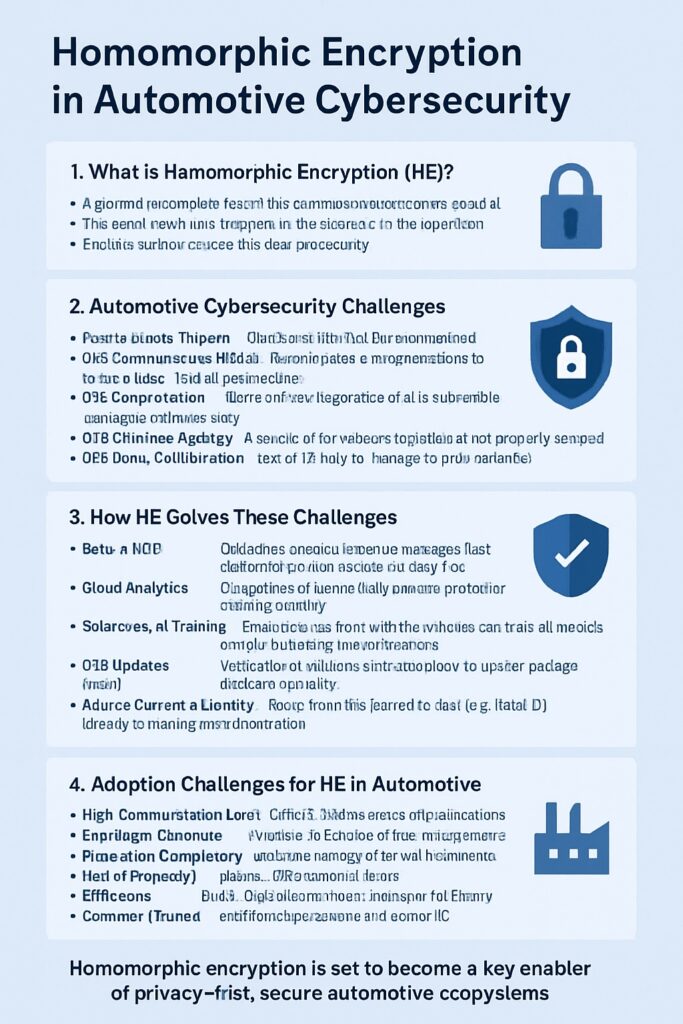
How Homomorphic Encryption Helps Automotive Cybersecurity
Homomorphic encryption allows automakers and service providers to analyze and process encrypted data without ever exposing it. Here’s how it addresses specific use cases:
1. Secure V2X Communication
- Vehicles can encrypt their location, speed, or alerts and share them with others or infrastructure nodes.
- Using HE, those nodes can process and respond to encrypted data without seeing it, preventing eavesdropping or manipulation.
2. Privacy-Preserving Cloud Analytics
- HE enables cloud servers to analyze vehicle telemetry, usage patterns, or diagnostics without decrypting the data.
- OEMs get insights while preserving user privacy and IP.
3. Federated Learning for AI Models
- Training self-driving algorithms or battery management systems requires data from many vehicles.
- HE allows encrypted model training — so data stays private, but the AI gets smarter.
4. Securing OTA Software Updates
- HE can validate encrypted update packages and verify integrity without revealing sensitive update logic.
5. Driver Identity & Access Control
- Facial recognition or biometric data can be verified securely using HE, even in shared mobility environments.
Companies Pioneering Homomorphic Encryption
Several leading firms and startups are developing or applying homomorphic encryption in automotive and broader cybersecurity contexts:
| Company | Focus Area |
|---|---|
| Zama (France) | Open-source FHE tools (Concrete, TFHE) for privacy-preserving AI |
| Duality Technologies (USA) | Secure data collaboration using HE, applicable in mobility |
| Inpher (USA/Switzerland) | Privacy-preserving computation for enterprise & edge use cases |
| Enveil (USA) | Homomorphic encryption for secure data usage and analytics |
| Microsoft SEAL (USA) | Open-source HE library used in research and commercial pilots |
| IBM HELib (USA) | Fully homomorphic encryption library used in secure AI research |
| Cosmian (France) | Tools to secure sensitive data using HE in analytics workflows |
Several automakers, including Volkswagen Group, Toyota, and BMW, are actively exploring homomorphic encryption through academic collaborations and pilots in their data privacy and AI initiatives.
Roadblocks to Adoption
While the promise of homomorphic encryption is huge, challenges remain:
- Computational Overhead: FHE is still significantly slower than traditional computation.
- Hardware Limitations: Vehicle ECUs are constrained in terms of power and memory.
- Integration Complexity: Requires overhaul of how data pipelines are designed and secured.
- Standardization: Lack of automotive-specific HE standards or plug-and-play libraries.
Final Thoughts
Homomorphic encryption has the potential to redefine how the automotive industry approaches cybersecurity. It offers a powerful privacy-preserving mechanism in a world where vehicles are not just transport machines — but intelligent, connected data centers on wheels.
As the industry navigates the shift to software-defined vehicles and AI-driven features, homomorphic encryption can become a cornerstone of trust, ensuring that even as data flows freely, privacy never takes a back seat.
Please note: Content curated and structured with the assistance of ChatGPT by OpenAI. Final edits and insights by Maneesh Prasad


