
August 2025
The automotive world is racing into a new era — one defined by hyperconnectivity, autonomous intelligence, and real-time responsiveness. As vehicles evolve into rolling data centers and edge-computing hubs, the demand for faster, smaller, and more energy-efficient processing is skyrocketing.
Enter ‘Photonics chips‘ — a revolutionary hardware platform that processes data at the speed of light.
Combined with the impending rollout of 6G wireless technology, photonic chips could be the missing link in unlocking ultra-low latency, real-time perception, and seamless vehicle-to-everything (V2X) communication. Here’s how this light-speed leap in hardware could change the rules of the road.
What Are Photonics Chips?
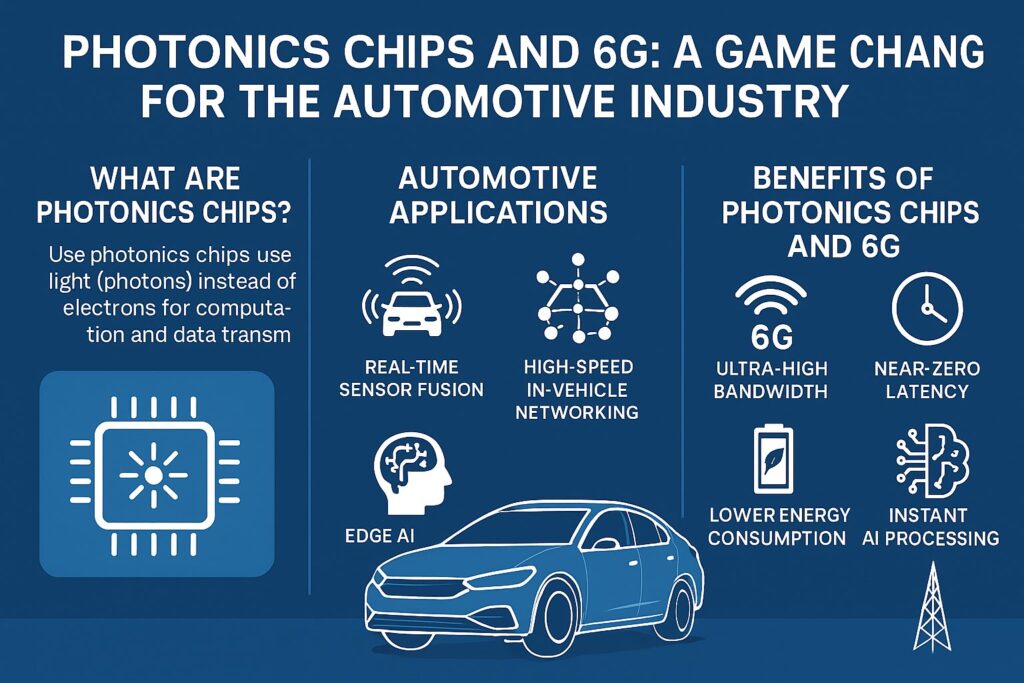
Photonics chips (also called optical chips) use light (photons) instead of electrons to perform computations and transmit data. These chips use tiny integrated optical circuits that manipulate light through waveguides, lasers, and modulators, much like how electronic circuits handle electric currents.
Unlike traditional silicon-based processors, which are approaching their physical and thermal limits, photonic chips offer massively parallel data processing with:
- Ultra-high bandwidth
- Near-zero latency
- Lower energy consumption
Why Do Cars Need Photonics?
Modern vehicles — especially autonomous and connected vehicles — generate and process terabytes of data per day from:
- LiDAR, radar, and camera arrays
- Onboard AI inference engines
- Real-time V2X communications
- Over-the-air (OTA) updates and infotainment systems
Traditional electronic systems strain to keep up. Here’s how photonics changes the game:
1. Real-Time Sensor Fusion
Photonics enables instantaneous data fusion from multiple sensors, allowing autonomous vehicles to make split-second decisions based on a full 360° understanding of their surroundings.
2. High-Speed In-Vehicle Networking
Photonics can replace traditional CAN and Ethernet buses with optical interconnects, offering ultra-high-speed, low-latency links between computing modules, reducing bottlenecks in ADAS and infotainment systems.
3. Edge AI Acceleration
Light-based AI accelerators can handle real-time image recognition and path planning with dramatically lower power draw — ideal for EVs where battery efficiency is critical.
Photonics + 6G = The Automotive Nervous System
6G networks (expected to debut by 2030) promise speeds up to 100x faster than 5G, with sub-millisecond latency and support for massive IoT. When combined with photonic chips, the automotive industry gets:
| Feature | 6G Alone | 6G + Photonics Chip |
|---|---|---|
| Peak Download Speed | ~1 Tbps | Instant AI processing at the edge |
| Latency | <1 ms | Near-zero, real-time decisions |
| Vehicle-to-Vehicle (V2V) | Fast data exchange | Instant sensor map sharing |
| Edge AI | Limited by silicon speed | Light-speed inference at endpoints |
| Network Congestion | Reduced | Load shared by onboard photonic edge |
Key Use Cases:
- Cooperative autonomous driving (vehicles sharing sensor data in real time)
- High-speed predictive navigation (cloud-AI fusion with onboard inference)
- Real-time AR/VR for passengers (including holographic heads-up displays)
Who’s Working on It?
Several industry leaders are actively exploring photonic chips for automotive and telecom:
- Lightmatter and Lightelligence: Developing AI photonic processors that could power edge compute in vehicles.
- Intel and IBM: Investing in silicon photonics for datacenters and exploring vehicle-grade adaptation.
- Cisco and Nokia: Building the optical backbones that will enable 6G infrastructure.
- Mercedes-Benz, Audi, and Tesla: Testing photonic interconnects and 6G-ready modules.
Challenges Ahead
Despite the promise, wide-scale adoption of photonic chips faces hurdles:
- Integration with existing electronic systems
- Thermal and durability concerns in harsh automotive environments
- Manufacturing scalability and costs
- Standardization across telecom and automotive protocols
However, as 6G trials expand and demand for in-vehicle intelligence grows, automakers and Tier 1 suppliers are increasingly investing in photonics R\&D.
The Road Ahead
The convergence of photonics chips and 6G wireless networks could mark the beginning of a new vehicular computing paradigm — where vehicles operate with a brain-like ability to sense, think, and respond in real time, powered by light and connected through airwaves.
In the coming decade, your car may not just be electric — it could be photonic and 6G-native, capable of navigating, collaborating, and entertaining at the speed of light.
Please note: Content curated and structured with the assistance of ChatGPT by OpenAI. Final edits and insights by Maneesh Prasad.


