Press Release, 20 June 2025
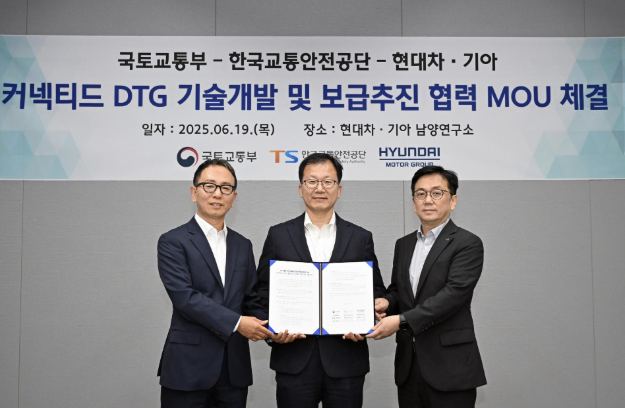
Hyundai Motor and Kia have signed a partnership with the Ministry of Land, Infrastructure and Transport and a transportation safety authority to jointly develop a next-generation connected digital tachograph (DTG) technology, the carmakers said.
A digital tachograph is an electronic device installed in commercial vehicles, such as trucks and buses, to digitally record essential information about the vehicle’s movement and the driver’s activity. It’s a crucial tool for ensuring road safety, fair competition among transport companies, and compliance with regulations regarding drivers’ hours of service (HOS) and rest periods– Mobility and Transport, European Commission.
Under the partnership, the two auto brands under Hyundai Motor Group aim to improve convenience for commercial vehicle customers and promote a culture of enhanced road safety by leveraging their advanced connected car technologies, they said.
The new connected DTG system will integrate the two carmakers’ connected vehicle services with the Korea Transportation Safety Authority (KTSA)’s electronic tachograph analysis system (eTAS). The DTG is an electronic device that automatically records driving information, such as speed, mileage and GPS signals, in real-time.
Under Korea’s road traffic act, buses, freight trucks and school vehicles are required to install DTGs and submit driving records.
The KTSA analyzes the submitted data to identify risky driving behavior and prevent traffic accidents. However, commercial vehicle operators must manually extract data from the DTG using a USB device or pay for a separate data submission service.
Since October 2024, the mandatory use of DTGs has expanded to include large freight trucks with a load capacity of 25 tons or more and special-purpose vehicles weighing over 10 tons, increasing the demand for easier data submission methods.
To address the challenges, the carmakers and the two authorities plan to automate the entire process, from data storage and analysis to submission through the connected car platform.
The carmakers’ connected car services, including Hyundai Motor’s Bluelink and Kia Connect, already provide basic features such as navigation, voice recognition and security services.
The next-generation connected DTG will utilize data from the vehicle’s electronic control unit collected in real-time, which will be transmitted daily to the KTSA’s eTAS system via the connected car servers.
Once the service launches, commercial vehicles will no longer need to install physical DTG devices, which can cost up to 400,000 won ($290) per vehicle. The system also eliminates the need for manual data submissions, which will significantly improve record-collection rates.
Hyundai and Kia plan to complete development of the connected DTG system this year and implement it in new commercial vehicles starting in 2026.
The automakers also plan to collaborate with the KTSA on data-sharing initiatives to create new mobility services within their connected fleet management solution. These services will include driving behavior analysis and rest compliance monitoring.
“The public-private collaboration on data-sharing and technology is essential to activating the mobility service ecosystem,” said Park Sang-hyun, vice president at Hyundai Motor. “We will continue to develop vehicle data-based services to enhance customer convenience and fulfill our social responsibility for safety.”