
Press release, 19 December 2025
The Münchner Verkehrsgesellschaft (MVG) and Stadtwerke München (SWM) are taking a tangible step toward the future of urban mobility by testing an autonomous midibus on their own grounds in Munich. The test vehicle, a Karsan e-ATAK electric midibus outfitted with advanced sensors and autonomous driving software from technology partner ADASTEC, is currently being trialled on a dedicated route at the MVG/SWM site to evaluate how self-driving systems perform in real-world operational contexts. The e-ATAK is an 8-metre bus capable of seating up to 52 passengers and is reported to achieve a range of up to 300 kilometres per charge, making it a promising platform for local public transport applications once autonomous driving technologies mature.
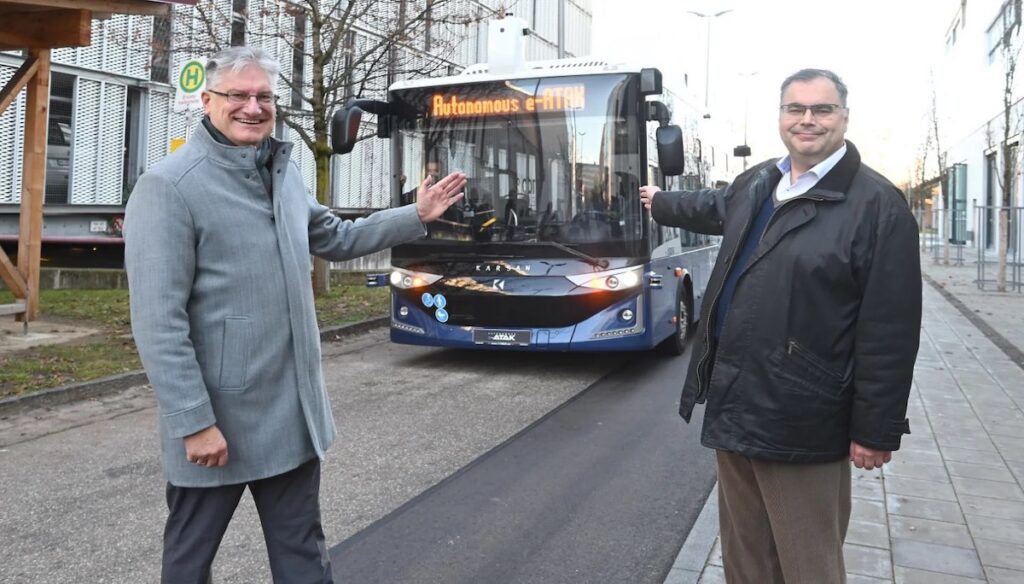
This initiative — first revealed in an official press release by MVG on 18 December 2025 — is aimed at collecting crucial data on the performance, safety, and reliability of autonomous vehicle systems in public transport scenarios. Unlike traditional buses that rely entirely on human drivers, the autonomous midibus uses a suite of sensors combined with ADASTEC’s automated driving system to perceive the environment, identify other road users, and make navigational decisions, including lane changes and turn manoeuvres under complex conditions. During the test period, which runs through the end of this week, engineers will monitor the bus’s behaviour, sensor responsiveness, localisation accuracy, and decision logic to assess how confidently the technology can handle everyday transit operations.
For MVG leadership, the pilot is part of a broader automation strategy that embraces new mobility technologies while carefully weighing their economic feasibility and real-world practicality. MVG CEO Ingo Wortmann has emphasized that autonomous buses could play a key role in future public transport networks if they meet standards for cost-effectiveness and operational robustness. The current test — focusing on sensor fusion, environmental perception, and autonomous decision-making — will inform future decisions about scaling up such vehicles across Munich’s transit system.
MVG Bus Director Veit Bodenschatz explained that the exercise is not just about proving autonomous technology in isolation, but understanding how it integrates with conventional transport workflows. The team’s evaluations will look at how effectively the vehicle recognises other road users, navigates intersections, and interweaves with conventional traffic — all essential elements for future deployment of such systems in urban settings. This real-world assessment of autonomous midsize buses builds on prior experiments MVG has conducted with flexible small buses earlier in October 2025, which explored automated service in suburban or tighter neighbourhood routes with positive results.
The data gathered from the current autonomous midibus trials will feed into MVG’s longer-term automation roadmap, which spans multiple vehicle types and use cases. Alongside flexible buses and planned on-demand autonomous shuttles in projects like MINGA (Munich’s automated local transport initiative), the midibus experiment is part of a multi-phased effort to integrate autonomous mobility solutions into public transport networks over the coming years. These pilots aim to refine vehicle control systems, enhance safety protocols, and lay the groundwork for larger scale deployment of autonomous buses and shuttles that could ultimately complement traditional services, particularly in low-density or peripheral urban areas.
By advancing such trials today, MVG and its partners hope to accelerate the adoption of autonomous public transport solutions that can address both sustainability objectives and operator efficiency challenges — especially as cities worldwide look to smart, scalable transit options to meet rising demand and environmental goals. This hands-on approach positions Munich at the forefront of intelligent mobility innovation, charting a path toward a future where automated buses could one day be commonplace on metropolitan streets.


