
A circular economy is an economic system that minimizes waste and maximizes resource value by designing products for reuse, repair, remanufacturing, and recycling, keeping materials in continuous circulation instead of disposing them after use.
In electric vehicles, a circular economy focuses on recovering critical battery minerals like lithium, cobalt, nickel, manganese, copper, and graphite from used batteries. Instead of depending only on fresh mining and imports, end-of-life EV batteries are collected, dismantled, recycled, and converted back into battery-grade materials. This reduces supply risk, cost volatility, environmental damage, and geopolitical dependence.
Why EV battery minerals matter so much
Electric vehicle batteries are mineral-intensive. A typical lithium-ion battery pack contains lithium, nickel, cobalt, manganese, copper, aluminum, and graphite—materials that are either scarce in India or entirely imported. Today, India imports more than 90% of its lithium-ion cells and almost all critical battery minerals, mainly from China-linked supply chains.
As EV adoption accelerates across two-wheelers, three-wheelers, cars, buses, and stationary storage, mineral demand is set to explode. This raises three strategic risks: supply security, cost stability, and sustainability. A circular economy directly addresses all three.
How circular economy works for EV batteries
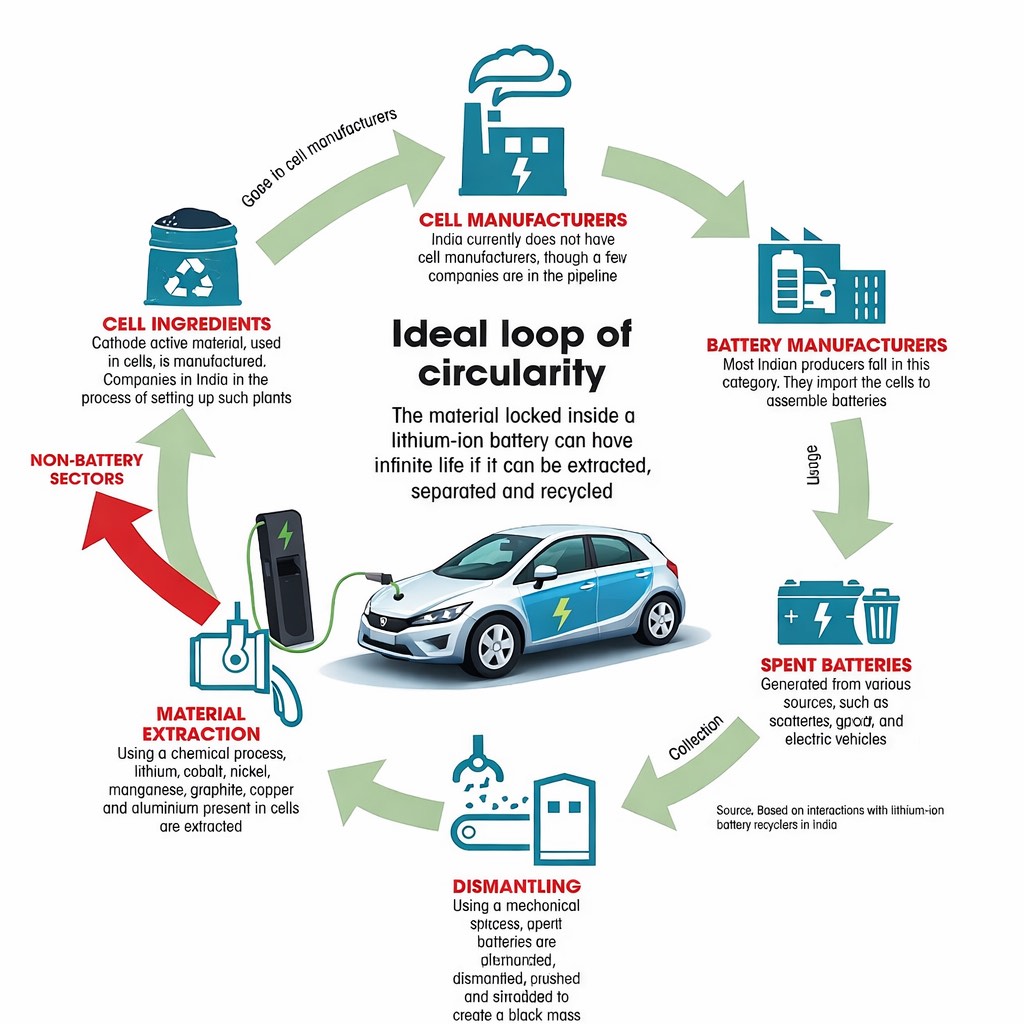
The circular economy for EV battery minerals typically follows four stages:
- Collection – Used or damaged EV batteries are collected from vehicles, fleet operators, charging stations, and manufacturers.
- Second life usage – Batteries that retain 70–80% capacity are repurposed for stationary storage, telecom towers, renewable integration, or backup power.
- Recycling & recovery – End-of-life batteries are mechanically shredded and chemically processed to recover lithium, cobalt, nickel, manganese, copper, and graphite.
- Re-manufacturing – Recovered minerals are refined into battery-grade materials and fed back into cell manufacturing.
This loop reduces mining intensity and keeps valuable minerals circulating within the domestic ecosystem.
Feasible for India
India is actually well-positioned to build a strong EV battery circular economy.
First, India already has a massive informal and formal recycling ecosystem for lead-acid batteries, electronics, and metals. This industrial muscle can be upgraded to lithium-ion recycling with policy support and technology investment.
Second, India’s EV market is skewed towards two-wheelers and three-wheelers, which have shorter battery life cycles (3–5 years). This means recyclable battery volumes will start appearing much earlier than in markets dominated by long-life passenger EVs.
Third, India has introduced dedicated policy frameworks to support battery recycling, extended producer responsibility, and domestic value creation. Together, these reduce regulatory uncertainty and encourage private investment.
How much mineral demand can circular economy meet?
In the near term (2025–2030), recycled battery minerals will meet a relatively small share of demand—primarily because EV penetration is still growing and most batteries are not yet reaching end-of-life.
However, from 2030 onwards, the picture changes significantly.
Theoretically:
- Lithium: 20–30% of demand could be met via recycling by the early 2030s.
- Cobalt & nickel: 30–40% recovery potential due to high recycling efficiency and economic value.
- Copper & aluminum: Over 90% recovery is technically feasible.
- Graphite: 20–25% recovery is possible as processing improves.
By the mid-2030s, a mature circular economy could realistically supply 25–35% of India’s total EV battery mineral requirement, significantly reducing import dependence.
Economic and environmental benefits
A circular battery economy lowers battery costs by reducing exposure to volatile global mineral prices. It cuts carbon emissions by avoiding energy-intensive mining and refining. It also creates domestic jobs in collection, logistics, processing, chemical engineering, and materials science.
From a national strategy perspective, battery recycling acts as a “virtual mine”—one that is cleaner, faster to scale, and geopolitically safer.
Challenges that still need solving
Despite its promise, challenges remain. Battery chemistries are evolving rapidly, making standardization difficult. Safe battery collection and transportation need strong enforcement. Recycling technologies must scale while maintaining purity levels required for modern batteries. Finally, India needs large-scale domestic cell manufacturing to fully close the loop.
Battery recycling players in India
Operating or scaling battery recycling
- Attero Recycling
- Lohum
- Exigo Recycling
- Gravita India
Exploring or piloting battery recycling
- Tata Chemicals
- Mahindra Group
- Maruti Suzuki
- Ola Electric
The road ahead
Circular economy for EV battery minerals is not optional—it is inevitable. For India, it represents a rare opportunity to convert a sustainability challenge into an industrial advantage. With the right mix of regulation, technology, and scale, recycled battery minerals can become a cornerstone of India’s EV and energy transition story.
References for further reading-
- Battery Waste Management Rules, 2022 – https://moef.gov.in
- Production Linked Incentive (PLI) Scheme for Advanced Chemistry Cells – https://www.niti.gov.in
- National Electric Mobility Mission – https://dhi.nic.in
- India’s Critical Minerals Strategy – https://www.mines.gov.in