Press Release, 19 November 2025
A new report by Yole Group titled Humanoid Robots 2026: Market & Technology Trends highlights how industrial-robot adoption is set to surge and names multi-sensor fusion as the driving force behind next-gen machine intelligence. The report features the “Eyes of Robots” Active Camera series from RoboSense Technology Co., Ltd. as a prime example of what happens when LiDAR, RGB camera and IMU are tightly integrated at the hardware level — enabling compact, efficient robotic vision systems built for real-world industrial deployment.
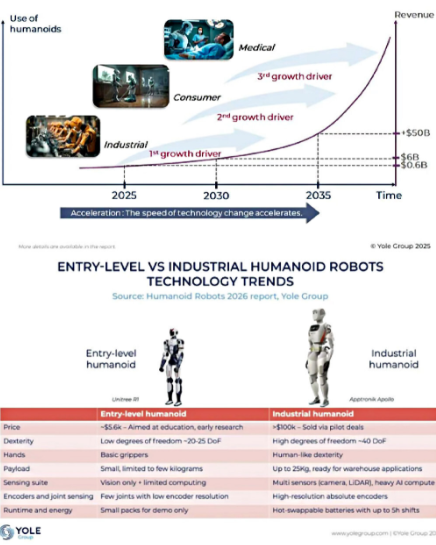
According to the findings, the global humanoid-robot market could reach about US $51 billion by 2035, with an anticipated compound annual growth rate of 55%. In industrial settings, the report argues that the difference between a basic experimental robot and a commercially valuable one often comes down to its sensor configuration: tighter fusion and smarter perception enable high-precision tasks, reliability in challenging conditions and a lower cost-and-complexity footprint. RoboSense’s AC1 Active Camera is cited as a “hardware-level fusion” solution that sidesteps cumbersome stacked sensors, delivering synchronized depth, image and motion data in one device — a key step toward scaling robotic vision.
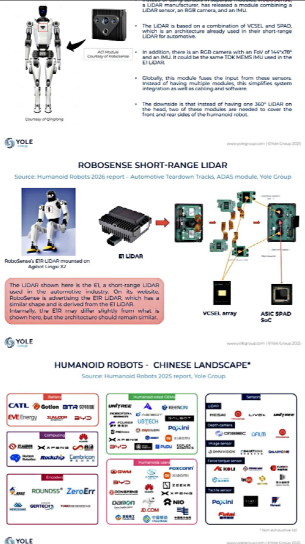
In short, as robotics moves from lab to factory floor, vision is no longer just “seeing”: it’s about combining signals, computing in real time, and integrating into one slim, rugged sensor. The Active Camera is positioned as the “eyes” of that future — and the Yole report makes clear that choosing the right vision system will define which robots succeed in the real world.
Compiled using AI