
Press Release, 16 December 2025
The global automotive industry is steadily moving toward 800V architectures for battery electric vehicles, marking a significant evolution from the long-established 400V systems. According to recent analysis by IDTechEx, this shift is no longer experimental but increasingly mature and commercially proven. While 400V platforms will continue to serve entry-level and cost-sensitive EV segments over the next decade, 800V systems are becoming the preferred choice for performance-focused and premium models due to their clear technical and economic advantages. Higher voltage allows vehicles to charge at much higher power levels while drawing lower current, enabling faster charging that more closely matches the convenience of refueling conventional vehicles. At the same time, reduced current flow cuts energy losses across the drivetrain, improving overall efficiency and allowing manufacturers to either extend driving range or reduce battery size, weight, and cost.
This transition has a ripple effect across the entire powertrain, particularly in power electronics. Wide bandgap semiconductors such as silicon carbide (SiC) are emerging as a natural fit for 800V platforms, offering higher efficiency and better performance than traditional silicon-based components at elevated voltages. Another often-overlooked benefit is the impact on vehicle wiring. Lower current requirements enable thinner wiring harnesses, reducing copper usage, vehicle weight, and material costs—an important consideration as automakers work to improve EV profitability in a highly competitive market.
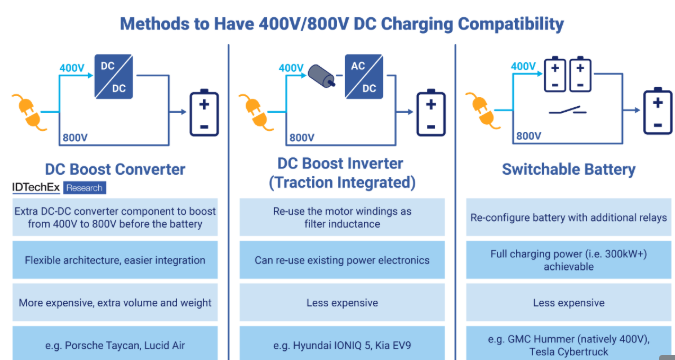
However, widespread adoption of 800V systems faces one practical challenge: most public DC fast chargers globally still operate at 400V. To bridge this gap, IDTechEx highlights three main technical approaches being used by automakers and suppliers. These include standalone DC boost converters, battery cell reconfiguration through series-parallel switching, and traction-integrated onboard chargers that use motor windings to raise voltage during charging. Each method comes with trade-offs in cost, complexity, and packaging, but together they demonstrate how the industry is innovating to ensure backward compatibility while pushing EV technology forward. As charging infrastructure and vehicle platforms evolve in parallel, 800V systems are set to play a central role in the next generation of electric mobility.
Compiled using AI


